Hear from Our Customers
When you’re running a pharmacy on Route 1 in Edison, managing a bank branch in Hackensack, or overseeing a school district facility in Middlesex County, the threat environment isn’t abstract. The DEA issued specific warnings in April 2024 citing New Jersey as one of the states experiencing a surge in pharmacy break-ins. A Union County man was charged with bank robbery and multiple armed convenience store robberies across the state.
These aren’t national statistics applied to New Jersey — they’re New Jersey incidents, in New Jersey communities.
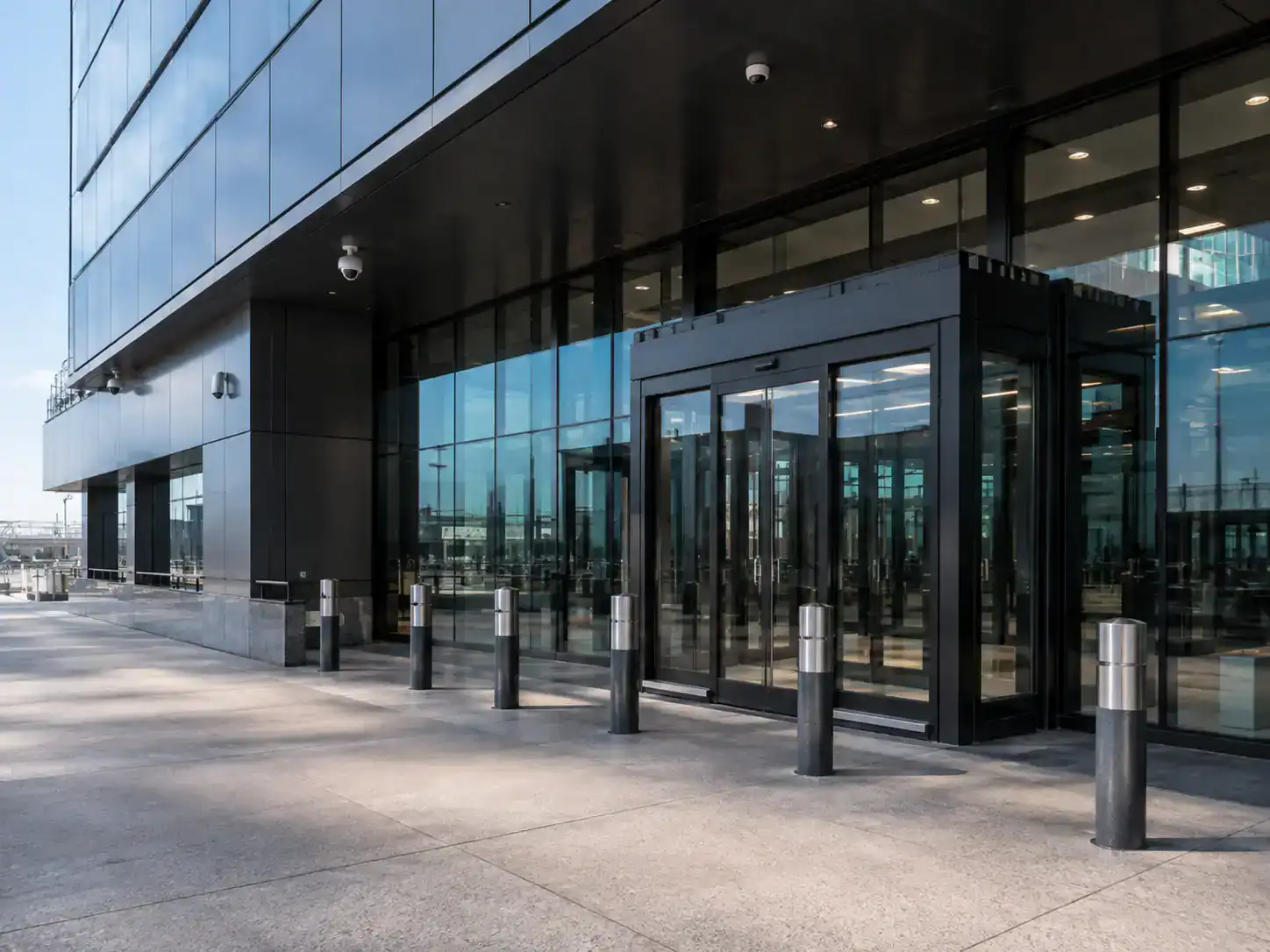
Bullet resistant glass in New Jersey doesn’t just reduce risk. It changes the operational reality of your space. Staff work with more confidence. Insurance conversations shift. Liability exposure narrows. When something does happen — an attempted robbery, a smash-and-grab on a high-traffic commercial corridor, a threat at a school entrance — the barrier between that event and your people is doing exactly what it was engineered to do.
New Jersey’s commercial building stock skews older, particularly in urban corridors like Newark, Trenton, Camden, and Paterson. Older storefronts and institutional buildings were never designed with modern ballistic standards in mind. That creates a large retrofit market, and retrofitting correctly — with rated framing, rated glazing, and a system that integrates with existing architecture — is where the difference between a real solution and a false sense of security gets made.
We’ve been designing and manufacturing bullet resistant windows, doors, storefronts, curtain walls, and transaction systems for more than 45 years. The company was founded in direct response to real-world crime against vulnerable workers — not as a market opportunity, but as a necessity. That origin still shapes how every system we build works.
Our manufacturing facility is in West Islip, New York — within the Tri-State Area and within practical proximity of New Jersey’s commercial markets. When a Bergen County contractor needs engineering documentation for a permit application, or a Newark facilities manager needs a system that meets GSA federal building standards, there’s no cross-country logistics chain in the way. We’ve been serving the New York metropolitan area for over four decades, which means the institutional, government, and commercial buyers that define New Jersey’s market are exactly the buyers we were built for.
Our co-owner Joseph Hayes holds a Professional Engineer (PE) license and LEED AP credential. That matters in a state with 565 municipalities — each with its own construction code enforcement office — where PE-stamped drawings and technical specifications aren’t optional.
It starts with understanding your specific threat environment and building conditions. A pharmacy on Route 9 in Woodbridge has different exposure than a federal office building in Newark or a school entrance in Mercer County. The right UL 752 protection level — and the right system configuration — depends on what you’re actually protecting against, not on a default recommendation from a product catalog.
Once the threat level and system requirements are established, we engineer a custom system: rated glazing, rated framing, hardware, and any transaction window or pass-through components the application requires. Because New Jersey adopted the 2024 International Building Code under its Uniform Construction Code in August 2026, any installation that modifies the building envelope requires a building permit from the local construction code official. Our PE-led engineering team provides the architectural drawings, 3-part specifications, and technical data sheets that New Jersey’s permitting process requires — documentation that a local glazier adding bullet resistant glass to a general product line typically cannot produce.
Installation is coordinated to minimize operational disruption. For retail and banking clients on high-traffic corridors like Route 22 or the Garden State Parkway service areas, that means realistic scheduling conversations upfront. After installation, the system is fully tested. If the glass ever takes a hit, it needs to be replaced — not because it failed, but because ballistic glazing that has absorbed an impact no longer has the structural integrity to absorb another one.
Ready to get started?
New Jersey’s security needs don’t fit a single profile. A late-night convenience store in Camden needs something very different from a pharmaceutical manufacturing facility in Parsippany or a federal courthouse in Newark. We manufacture systems across all 10 UL 752 protection levels — from Level 1 for handgun threats common in retail environments to Levels 7 and 8 for rifle-rated protection in government and military applications. Most competitors cap at Level 8. We don’t.
Our product line includes bullet resistant windows, bullet resistant doors, bullet resistant storefronts, bullet resistant curtain walls, bullet resistant transaction windows with stainless steel framing and deal tray options, and fiberglass ballistic panels rated to UL 752 Levels 1 through 6. For applications where rigid panels won’t work — curved surfaces, complex architectural designs, vehicle applications — LytArmor Flex is our proprietary flexible ballistic panel, engineered to deliver bullet resistance without the weight or rigidity constraints of traditional armor.
Critically, our systems are rated for both ballistic and blast threats. For New Jersey’s concentration of pharmaceutical manufacturing, petrochemical facilities, and military installations — Joint Base McGuire-Dix-Lakehurst is the largest joint base east of the Mississippi — dual-rated protection isn’t a premium add-on. It’s the baseline requirement. Every system is manufactured in West Islip, New York, satisfying Buy American requirements for New Jersey’s government and institutional procurement processes. No offshore components. No assembly-from-parts reselling. Made in the USA, engineered by a licensed PE.
For most New Jersey retail environments — pharmacies, convenience stores, check-cashing windows, liquor stores — UL 752 Level 1 or Level 2 is the appropriate starting point. Level 1 is rated for three shots from a 9mm handgun, and FBI data consistently shows that handguns account for roughly 80% of retail incidents. If your location handles controlled substances, operates late hours in a high-crime corridor, or has experienced prior incidents, Level 3 is worth serious consideration.
The DEA specifically flagged New Jersey in April 2024 as a state experiencing elevated pharmacy break-in activity. That context matters when you’re sizing your protection level. The right answer isn’t always the highest level — it’s the level that matches your actual threat environment. Our engineering team can walk through your specific location, operating hours, and risk profile to help you land on the right specification before anything gets ordered or installed.
Yes, in virtually every case. Any installation that modifies the building envelope — replacing windows, installing a new storefront system, adding a transaction window that requires structural changes — is a structural alteration under New Jersey’s Uniform Construction Code (NJAC 5:23) and requires a building permit from the local construction code official.
New Jersey has 565 municipalities, and each one runs its own construction code enforcement office. Permit requirements, fees, and review timelines vary by town. What doesn’t vary is the need for proper documentation: architectural drawings, 3-part specifications, and technical data sheets that demonstrate the system meets code. New Jersey officially adopted the 2024 International Building Code in August 2026, which updated requirements for structural glazing systems and safety glazing in commercial buildings. Our PE-led engineering team produces all of that documentation as part of the project process — which is one of the practical reasons that working with a licensed engineer matters in a state with this level of municipal complexity.
Technically, yes — and it’s not just semantics. No glazing material is truly impenetrable at every caliber and velocity. “Bulletproof” is a marketing term. “Bullet resistant” is the accurate description, and it’s the language used by UL 752, the industry’s governing standard for ballistic testing in North America.
UL 752 certification means the material has been independently tested against specific ammunition types, velocities, and shot patterns — not self-declared by the manufacturer. A Level 1 system has been tested against three shots from a 9mm at defined distances and velocities. A Level 8 system has been tested against five shots from a .308 rifle. When you’re evaluating a product, the question isn’t whether it’s “bulletproof” — it’s what UL 752 level it’s certified to, and whether that level matches the threat your facility actually faces. Any product that doesn’t carry a verified UL 752 certification is a liability, not a solution.
New Jersey has been actively expanding its school security legislative framework. The NJ School Safety and Security Task Force, established under P.L.2023, c.218, has a mandate that includes hardening school perimeters and building entryways. Assembly Bill 3656, introduced in February 2024, requires specific security measures to be incorporated into new school construction and existing school buildings. Assembly Bill 6087, introduced in November 2025, is establishing a Commission on College and School Safety and Security with ongoing oversight authority.
Whether a specific installation is required depends on the type of project, the school’s occupancy classification, and the recommendations that emerge from the Task Force’s formal guidance. What is clear is that the legislative pipeline is generating real capital projects across New Jersey school districts — and those projects require UL 752-certified glazing systems with full engineering documentation. If you’re a school district facilities director or an architect working on a New Jersey school project, the time to get specifications in order is before the project goes to bid, not after.
A properly installed bullet resistant glazing system will typically last 15 to 20 years before issues like yellowing or crazing become significant enough to warrant replacement. Polycarbonate and acrylic materials are more susceptible to UV degradation over time, which is why UV-resistant coatings matter — especially for exterior-facing applications in New Jersey, where summer UV exposure is significant and nor’easter-driven temperature cycling puts stress on seals and frames over the years.
The one non-negotiable replacement trigger is impact. If your barrier takes a ballistic hit, it needs to be replaced — full stop. Bullet resistant glass that has absorbed a shot no longer has the structural integrity to absorb another one. That’s not a flaw in the product; it’s how the physics works. The material did its job. Now it needs to be replaced so it can do its job again. We provide expert support throughout the life of the system, including guidance on replacement timing and specifications when that point comes.
Yes, and this is one of the more important questions to ask before you commit to a system. New Jersey’s commercial building stock ranges from historic storefronts in Hoboken and Princeton to modern glass towers in Jersey City to the dense suburban strip commercial corridors along Route 22, Route 46, and Route 17 through Paramus. A bullet resistant storefront that looks like a security retrofit — thick frames, mismatched profiles, institutional aesthetics — undermines the customer experience you’ve built and signals to your customers that something is wrong.
We engineer every system to integrate with existing architectural aesthetics. Our aluminum storefront series is designed to maintain the visual appearance expected in today’s commercial environments, and custom sizing means the system fits your opening — not the other way around. For high-value retail on the Route 17 corridor in Bergen County or a bank branch in a mixed-use development in Jersey City, that architectural integration isn’t cosmetic. It’s part of what makes the system work for your business, not just against a threat.
Useful Links
Other Services we provide in New Jersey