45 Years of Engineering Experience
We have designed and manufactured certified ballistic glazing systems for government and institutional clients for over four decades.

Bullet Resistant Detention Windows United States
A single weak point in a detention window assembly puts your staff at risk. We engineer bullet resistant detention windows as complete, certified systems - frame, glazing, and hardware - built to your exact specifications. Every component is tested together, so the certification that leaves our facility is the certification that protects your staff.

The Action difference
We have designed and manufactured certified ballistic glazing systems for government and institutional clients for over four decades.
Our detention window systems carry independent UL 752 ballistic certifications, verifiable through Underwriters Laboratories - not just marketing language.
Every system is manufactured at our facility in West Islip, New York, supporting Buy American compliance for federal and state correctional procurement.
Our products hold Florida Product Approval certification, satisfying state-level regulatory requirements for government construction projects across the southeastern U.S.

Correctional Facility Security Windows United States
Correctional facilities in the United States face a threat profile unlike any other built environment. The risks at a jail control room window are not the same as a bank teller counter - you are dealing with sustained blunt-force attacks from inside, potential ballistic threats from outside, improvised tools, and the constant pressure of an environment where containment is the baseline requirement.
Standard glazing products were not designed for this. A bullet resistant detention window needs to meet multiple standards simultaneously - not just one - and the frame holding that glass has to perform just as well as the glazing itself. That is where most glazing specifications fall short, and where we focus.
We custom-engineer detention security glazing systems for jails, state and federal prisons, county detention centers, juvenile facilities, and behavioral health units across the United States. Every system is built to your project's exact opening dimensions and threat requirements, with certifications that remain intact from our shop to your facility.
Detention Security Glazing United States
Prison Security Barrier Standards United States
This is the part most vendors gloss over. Correctional facilities in the United States require glazing that can handle fundamentally different types of attacks - and no single certification covers all of them.
ASTM F1915 is the standard built specifically for detention environments. It tests glazing against blunt impact, sharp instrument strikes, and localized flame exposure - the improvised threats that happen from inside a facility. At Grade 1, that means surviving 60 minutes and 600 total impacts. Even Grade 4, the entry level, requires withstanding 10 minutes and 100 impacts. That is a significant engineering challenge for any glazing product.
ASTM F1233 covers sustained forced-entry resistance using tools, thermal attack, and chemical exposure - a multi-stage test that goes well beyond what ASTM F1915 addresses. UL 752 covers ballistic resistance, from Level 1 (three shots from a 9mm handgun) up through Level 8 (five shots from a 7.62mm rifle). All three standards address different threats. A window that passes one may not pass the others.
We engineer our detention security glazing systems to be specified across all three standards simultaneously, so the glazing you install actually covers the threat profile your facility faces - not just the threat profile that was easiest to test.
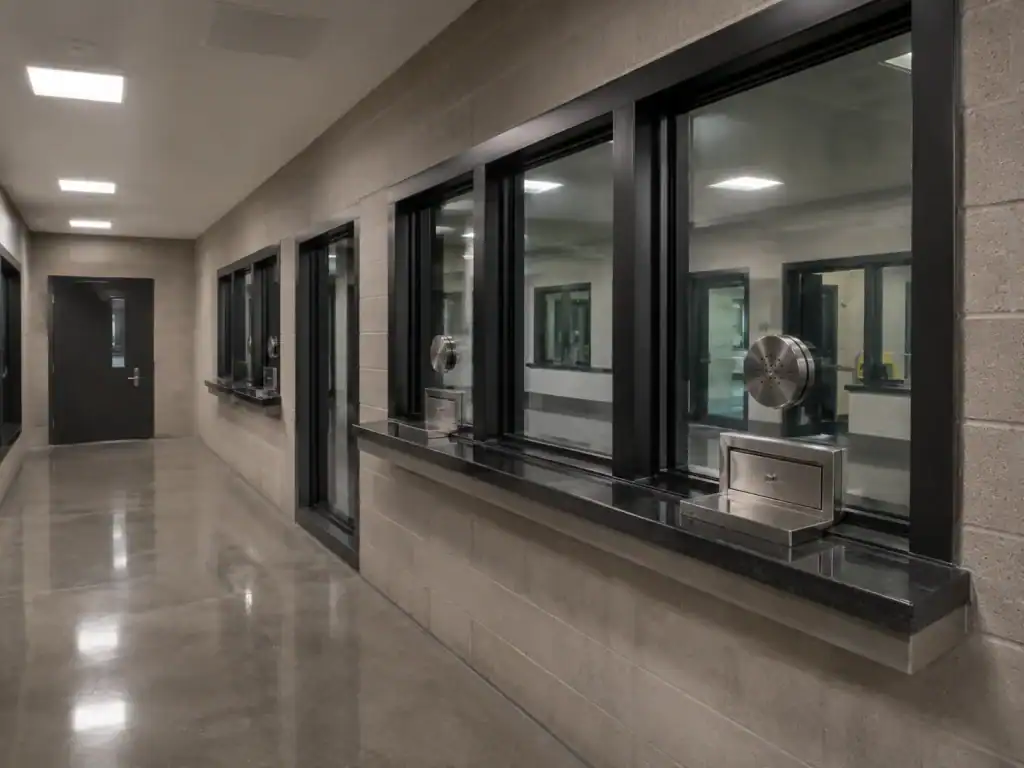

Ballistic Protection for Jails United States
Most glazing failures in correctional environments do not happen at the center of the glass. They happen at the frame, at the glazing-to-frame interface, or at the transaction hardware - the parts of the assembly that do not always receive the same engineering attention as the glass panel itself.
A ballistic-rated glass panel installed in an uncertified frame is not a certified ballistic system. In a government correctional facility, that distinction carries real liability. It also means that if something happens at that opening, the protection you thought you had was never actually there.
Our detention window systems use aluminum, cold-rolled steel, or stainless steel frames that are engineered and tested as part of the complete assembly. The frame captures and retains projectiles. The glazing-to-frame interface is designed to hold under sustained attack. The transaction hardware - where staff interact with detainees - is built to the same protection level as the rest of the unit. When we deliver a certified system, the certification covers the whole thing.
Jail Control Room Window Process United States
We start by understanding your facility's threat profile, application zones, and opening dimensions - so the specification is right before anything is built.
Every system is custom-engineered to your project's dimensions and ballistic requirements, with certifications intact - no field modifications required.
Your certified, ready-to-assemble detention window system ships from our West Islip, New York facility, built to integrate directly into your project without surprises.
No - and over-specifying is just as much of a problem as under-specifying. Bullet resistant detention windows are specifically required at staff interface points where firearm threats are a realistic concern: control rooms, sally ports, visitation areas, entry points, and perimeter staff stations. Cell windows in general housing areas, for example, typically require impact-resistant and forced-entry-resistant glazing - but not necessarily ballistic-rated glazing. The right specification depends on the application zone, the threat profile for that zone, and the standards your jurisdiction requires. We can walk through that zone-by-zone assessment with your architect or project team so every opening in your facility gets the right level of protection - not more than necessary, and not less.
They test for completely different threats, which is why correctional facilities across the United States typically need to reference both. ASTM F1915 was developed specifically for detention and psychiatric environments. It evaluates glazing against the kinds of attacks that happen from inside a secured facility - blunt impact from objects, sharp instrument strikes, and localized flame exposure. UL 752 is the ballistic standard. It tests glazing against defined firearm threats, from 9mm handgun rounds at Level 1 up through 7.62mm rifle rounds at Level 8. A window that meets ASTM F1915 may not meet UL 752 ballistic requirements, and vice versa. For most correctional security glazing specifications, both standards - along with ASTM F1233 for sustained forced-entry - should be addressed in the same assembly.
There is no such thing as bulletproof glass. The accurate term is bullet resistant - and the key word is "resistant." Every ballistic glazing product is rated against specific, defined threats at specific velocities. UL 752 Level 3, for example, is tested against three shots from a .44 Magnum handgun. That does not mean the glass will stop a .50 caliber round or a sustained rifle attack beyond its rated level. What it does mean is that the glazing has been independently tested and certified to resist the threats defined in that level. Understanding what your glazing is rated for - and specifying the right level for each application zone - is how you build real protection into a correctional facility.
Yes, and this is one of the most important things to get right. Correctional facilities across the United States rarely have perfectly standard opening dimensions - especially in renovation projects where you are working within existing structural conditions. The problem with forcing a standard product into a non-standard opening is that field modifications to certified glazing assemblies can void the certification. Once that certification is voided, you no longer have a tested, listed system - you have glass in a frame with paperwork that does not actually apply to what was installed. We engineer every detention window system to your exact project dimensions from the start, so the certifications that come with the system reflect what is actually being installed in your facility. No workarounds, no voided listings.
This is one of the first questions government procurement officers ask, and it matters early in the specification process. Federal correctional facility projects - including Bureau of Prisons construction and renovation - are subject to Buy American Act requirements. Many state correctional systems and county jail projects have similar domestic manufacturing preferences written into their procurement rules. Our detention security glazing systems are manufactured at our facility in West Islip, New York, which means we can provide the domestic manufacturing documentation that government procurement requires. We also hold Florida Product Approval certification, which is specifically relevant for correctional construction projects in Florida and other hurricane-zone states along the Gulf Coast and southeastern U.S.
The right UL 752 level depends on the specific threat environment for each application zone within your facility. As a baseline, all detention doors that meet ASTM F1450 are required to carry a minimum UL 752 Level 3 ballistic rating - so Level 3 is the floor for any certified detention door assembly. Control room windows at facilities where staff are exposed to potential firearm threats from detainees or external perimeter threats are typically specified at Level 3 or higher, depending on the facility's security classification. Higher-security state and federal facilities may specify Levels 5 through 8 for perimeter-facing openings. The honest answer is that there is no one-size-fits-all level - it depends on your facility type, security classification, and the threat assessment your security consultant has conducted. We work with architects and security consultants across the United States to help translate that threat assessment into the right ballistic specification for each zone, so the glazing you install actually matches the risk you are managing.
Start with the right specification
Send us your drawings, your requirements, or your questions. Talk with the team that engineers and manufactures your system.