UL 752 Levels 1 Through 10
We manufacture to the full UL 752 ballistic spectrum - independently tested, not self-certified - so your spec is backed by documentation insurers and procurement officers can verify.
Bullet Resistant Stadium Security United States
Most U.S. venues have some security in place. But a bullet resistant window surrounded by standard drywall isn't a barrier - it's a gap with glass in the middle. We build complete ballistic systems for sports and entertainment venues across the United States, engineered from the frame out.

The Action difference
We manufacture to the full UL 752 ballistic spectrum - independently tested, not self-certified - so your spec is backed by documentation insurers and procurement officers can verify.
Co-owner Joseph Hayes is a licensed PE and LEED AP. Complex venue projects requiring stamped drawings get engineering leadership, not just a sales contact.
We've designed and manufactured ballistic systems domestically for over 30 years - no overseas sourcing, no quality gaps, no supply chain surprises on your project timeline.
Windows, doors, wall panels, storefronts, transaction hardware - we make every component of a full ballistic barrier, so your installation isn't a patchwork of mismatched vendors.

Stadium Ballistic Protection, United States
Over 292 million people attended sporting events in the United States in 2024. That kind of foot traffic - compressed into a few hours, moving through a handful of entry points - creates a security challenge unlike almost any other built environment.
Ticket windows, box offices, security command posts, cashier stations, VIP access points: each one is a potential exposure if the physical barrier isn't engineered as a complete system. We work with facility managers, architects, and general contractors across the U.S. to design and manufacture custom ballistic protection for sports stadiums, arenas, amphitheaters, and multi-use entertainment venues.
Every system is built to UL 752 standards and custom-engineered to fit your venue's specific dimensions, threat profile, and architectural requirements. This isn't a catalog product you drop into an opening. It's a system designed around your building.
Sports Venue Security Barrier Benefits
Arena Security Windows, United States
Here's something most venues don't find out until after installation: standard drywall adjacent to a bullet resistant window provides virtually zero ballistic resistance. That means a staff member sitting behind what looks like a protected barrier may actually be in a soft target zone - with a false sense of security that's arguably worse than no barrier at all.
This is the most common gap we see in U.S. sports and entertainment venues. A window gets installed. A box gets checked. And nobody looks at what's holding that window in place.
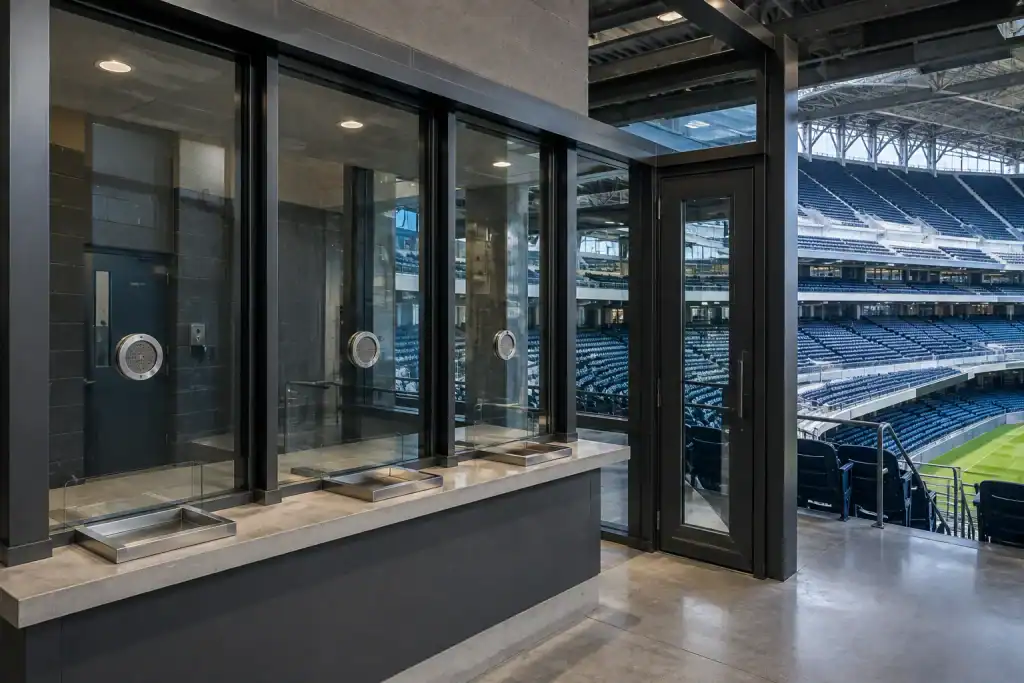
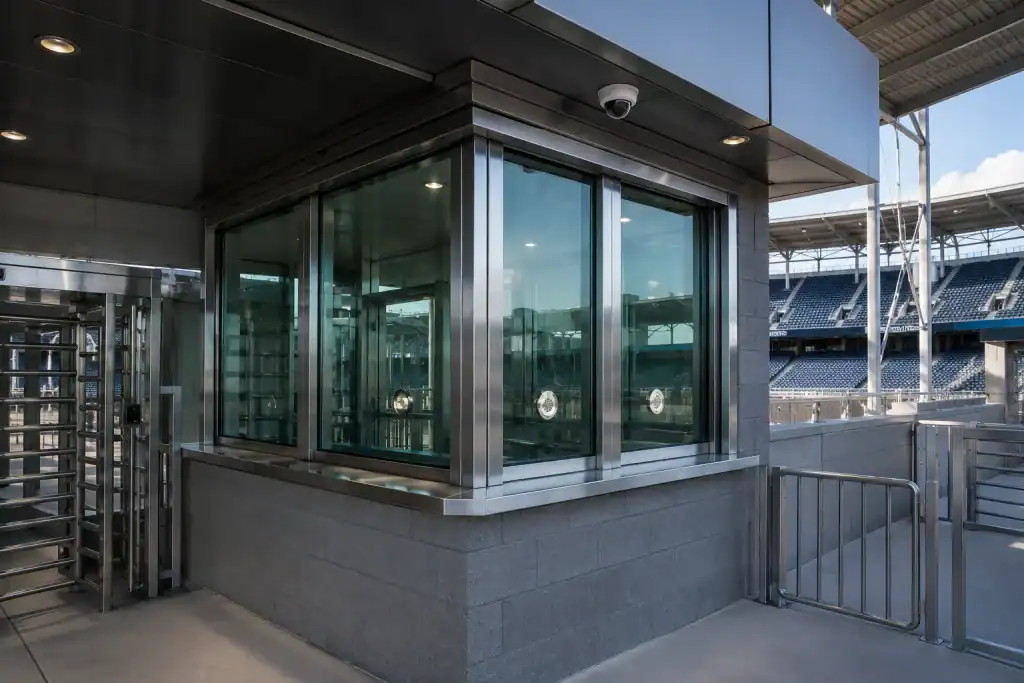
We address the complete barrier - glazing, frame, surrounding wall panels, and transaction hardware - as a coordinated system. Every component is engineered to work together, tested together, and documented together. When the threat comes from an angle, or hits the frame instead of the glass, your barrier holds. That's what a real arena security window is supposed to do, and it's the standard we've built to since 1992.
Box Office Security Barriers, United States
No two venues are the same. An NFL stadium box office has different dimensions, traffic flow, and aesthetic requirements than a university arena ticket window or a concert amphitheater cashier station. Off-the-shelf products that don't fit your existing structure create installation compromises - and installation compromises create protection gaps.
We custom-engineer every system to your venue's exact specifications. That means the right glazing configuration for your threat level, the right frame dimensions for your opening, the right communication setup for your staff, and the right finish to match your facility's design standards.
ADA compliance, weather resistance for outdoor installations, natural voice ports or intercom integration - these are part of the engineering conversation from the start, not afterthoughts bolted on at the end. Our co-owner holds a Professional Engineer license and LEED AP credential. For projects that require stamped drawings, code compliance documentation, or coordination with a design-build team, that engineering depth is available from day one.
Ballistic Protection for Stadiums Process
We review your venue layout, identify every exposure point, and discuss the appropriate UL 752 protection level for each application - before any engineering begins.
Your system is designed to your exact dimensions and specifications, then manufactured in the United States to UL 752 standards with full test documentation.
Systems ship pre-engineered for efficient field installation, minimizing disruption to your venue's operational calendar and reducing on-site fabrication time.
The most common applications we see in stadiums and arenas across the United States are ticket windows and box office counters, security command posts, cashier stations at concession areas, VIP access control points, and exterior entry barriers. The threat environment doesn't always come from inside the venue - the FBI's active shooter data and incident records from events like the 2024 Kansas City Super Bowl parade shooting confirm that large public gatherings tied to sports events face real perimeter and ingress risks. Any position where staff interact with the public through a fixed barrier, or where personnel are stationed in a semi-exposed location, is worth evaluating. We can walk through your venue layout and identify every exposure point before any engineering begins.
UL 752 is the Underwriters Laboratories standard for bullet resistant building components. It covers ten protection levels, ranging from Level 1 - which stops 9mm handgun rounds - up through Level 8, which stops 7.62mm NATO rifle rounds, and beyond. The right level for your venue depends on your specific threat profile, your location, and what your security assessment identifies as the most likely threat vectors. For most U.S. sports venue ticket windows and box office applications, Levels 1 through 3 address the most common handgun threats. Higher-risk environments or exterior-facing installations may warrant Level 4 or above. We cover the full UL 752 spectrum - Levels 1 through 10 - so we can spec the right level for each area of your facility rather than applying a one-size approach across the whole building.
Yes, and it matters. There is no such thing as bulletproof glass. The correct term - and the one used throughout the industry - is bullet resistant. Every ballistic glazing system is tested and rated to stop specific rounds at specific velocities. A Level 3 system stops .44 Magnum rounds. It was not tested against rifle ammunition, and it will not perform the same way against a higher-caliber threat. This is why proper threat assessment and correct UL 752 level specification matter so much. We're straightforward about this in every project conversation: the goal is a system that's rated and documented for the threats your venue actually faces - not a marketing claim that overpromises.
This is one of the most common practical concerns we hear from facility managers at active U.S. venues, and it's a legitimate one. Arenas that host NBA, NHL, concerts, and esports events in the same building have almost no off-season. Our systems are engineered as ready-to-assemble units - designed for efficient field installation with minimal on-site fabrication. That means less disruption to your operational calendar. We also work with your project timeline from the start, so installation can be phased around your event schedule where needed. The goal is to get your venue protected without creating a secondary problem in the process.
Not if they're engineered correctly. This is a real concern for NFL stadiums, NBA arenas, and premier concert venues that have invested heavily in fan experience design. A security barrier that looks institutional or industrial undermines the environment you've worked to create. Our approach - which we describe as building to design intent - means every system is custom-engineered to integrate with your venue's existing architecture, finishes, and aesthetic standards. Modern ballistic glazing offers excellent optical clarity. Frames can be finished to match your interior design specifications. The result is a barrier that functions as a serious protective system without signaling "fortress" to the tens of thousands of fans walking past it every event.
This is increasingly driving procurement conversations at venues across the United States, and for good reason. Insurance carriers are scrutinizing physical security measures more carefully, and failure to implement recognized standards can create liability exposure following an incident. Our products are manufactured to UL 752 standards through independent third-party testing - not self-certification. That means we can provide actual test documentation: the specific rounds tested, the number of shots, the protection level achieved, and the UL listing. This is the documentation your insurer, legal counsel, and risk management team need to see. We also meet NIJ, DOD minimum, and GSA Blast standards where applicable, which matters for government-affiliated venues and university facilities with federal funding considerations.
Start with the right specification
Send us your drawings, your requirements, or your questions. Talk with the team that engineers and manufactures your system.