UL Listed, Levels 1 Through 10
Independent UL testing - not self-certification - covers the full protection range, including Levels 9 and 10 most manufacturers never reach.
Fiberglass Ballistic Panels United States
Our fiberglass ballistic panels are what United States facilities rely on when protection needs to be invisible. They go in behind the drywall - fully UL Listed, engineered from Level 1 through Level 10 by a licensed Professional Engineer, and manufactured right here in West Islip, New York.

The Action difference
Independent UL testing - not self-certification - covers the full protection range, including Levels 9 and 10 most manufacturers never reach.
Joseph Hayes, PE, LEED AP leads our engineering team, bringing professional accountability and stamped documentation to every project we take on.
Every panel is built in West Islip, New York - domestic sourcing that matters for government procurement, GSA projects, and institutional specifications.
We engineer panels, framing, glazing, and doors to the same ballistic level - no mismatched components, no weak points, no liability gaps.

UL 752 Fiberglass Panel Overview
A fiberglass ballistic panel is a rigid, engineered composite - multiple layers of woven ballistic-grade fiberglass cloth compressed with thermoset polyester resin into a flat sheet. When a projectile strikes it, those layers delaminate against each other, creating friction that slows the bullet until it stops inside the panel. No penetration. No ricochet. No dangerous fragments on the protected side.
What makes fiberglass the right choice for most commercial, institutional, and government applications across the United States isn't just how it performs - it's how it installs. These panels go behind standard drywall and architectural finishes. Your building looks exactly the same after installation. That matters when you're protecting a school office, a bank teller area, or a government service counter where the goal is safety without the visual weight of visible barriers.
Fiberglass Wall Armor United States
Fiberglass Armor Panel Selection Guide
One of the most common mistakes buyers make is treating UL 752 levels like a simple scale where higher is always better. It doesn't work that way.
Levels 1 through 3 address handgun threats - 9mm, .357 Magnum, .44 Magnum - and are appropriate for most banks, school administrative areas, retail counters, and government service windows across the United States. Levels 4 through 6 step up to high-powered handguns and submachine gun threats, which is where police stations, courthouses, and high-risk commercial environments typically land. Levels 7 and 8 address assault rifle threats and are specified for military installations, embassies, and the highest-security government facilities. Levels 9 and 10 cover armor-piercing and specialized threats - a range most manufacturers don't even reach.
What matters here is that Levels 1 through 3 follow a linear progression, but above Level 3, the jumps are not linear. The difference between Level 4 and Level 8 is not just a little more protection - it's an entirely different threat category. Getting this wrong means either under-protecting your facility or significantly over-specifying and over-spending.
That's why we don't just hand you a product catalog. We walk through your threat environment, your application, and your building before we recommend anything.
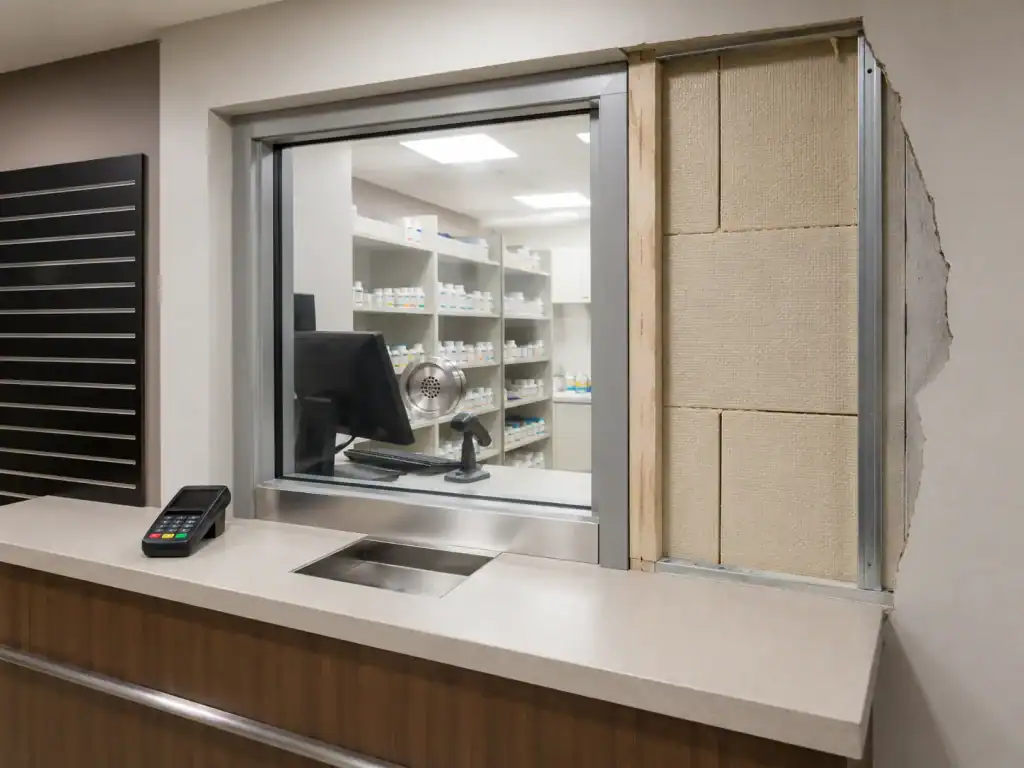

Lightweight Ballistic Panel Installation United States
This is something the industry doesn't talk about enough. A fiberglass ballistic panel installed in a wall is only as strong as everything around it. If the door next to it isn't rated to the same UL 752 level, that door is the weak point. If the frame isn't ballistic-rated, the frame is the weak point.
Piecemeal procurement - buying panels from one vendor, glazing from another, doors from a third - creates liability gaps that defeat the purpose of the investment.
At Action Bullet Resistant, we manufacture the full assembly: fiberglass ballistic panels, aluminum and steel ballistic framing, bullet-resistant glazing systems, transaction windows, storefronts, and doors - all engineered to the same protection level. When a single manufacturer designs and builds every component to the same UL 752 specification, the system performs as a system. That's what government procurement officers, security directors, and architects across the United States need when they're specifying protection for a real facility with real people inside it.
Bullet Resistant Fiberglass Board Process
We review your facility type, threat environment, and application to identify the correct UL 752 protection level - not the highest, the right one.
Our CAD designers and craftsmen engineer panels and full system components to your building's exact specifications, manufactured in West Islip, New York.
You receive your panels with full compliance documentation and installation guidance - everything your contractor, architect, or procurement office needs.
This distinction matters more than most buyers realize. A product that is "tested to UL 752" means the manufacturer ran their own tests - or had a one-time test done - and is reporting the results themselves. A UL Listed product has been independently tested by Underwriters Laboratories, a third-party organization with no financial interest in the outcome. Beyond the initial certification, UL Listed products also undergo quarterly maintenance testing, where random production samples are pulled without advance notice and retested. That ongoing accountability is what separates a genuine UL Listed panel from a self-certified claim. For institutional buyers, government procurement, and any project where documentation matters, UL Listed is the only standard worth specifying.
Yes, and this is one of the primary reasons fiberglass is the material of choice for retrofit projects across the United States. Fiberglass ballistic panels are significantly lighter than steel alternatives, which means they can typically be integrated into existing wall assemblies without reinforcing the structural system. They install behind standard drywall and architectural finishes, so the renovation footprint is much smaller than most facility managers expect. Schools upgrading administrative vestibules, banks hardening teller areas in existing branches, and government offices adding protection to service counters are all common retrofit applications. The key is getting the level selection right before you start - retrofitting the wrong level creates a false sense of security.
Completely. That's one of the most important practical advantages of fiberglass wall armor for institutional and commercial applications across the United States. The panels install behind drywall, sheetrock, or whatever architectural finish your building uses. From the inside, nothing looks different. There are no visible barriers, no reinforced aesthetic, no signal to building occupants or visitors that the walls have been hardened. For school administrators concerned about how security measures affect the environment for students, for bank managers who don't want to make customers feel like they're in a vault, and for healthcare facilities trying to maintain a welcoming atmosphere, this is often the deciding factor. The protection is there. Nobody needs to know it's there.
No. This is a common concern, and it's worth addressing directly. Fiberglass is non-conductive and transparent to radio frequencies, which means cellular signals, Wi-Fi networks, and security system communications pass through fiberglass ballistic panels without interference. This is a meaningful difference from steel ballistic barriers, which do block RF signals and can create dead zones in protected areas - a real problem when you need emergency communication systems, wireless security cameras, and staff devices to function reliably. For government facilities, schools, and healthcare environments where uninterrupted communications are critical, fiberglass is the right material for this reason alone.
For the vast majority of schools, banks, credit unions, and retail environments across the United States, UL 752 Levels 1 through 3 address the realistic threat environment. Level 1 covers 9mm handgun threats. Level 2 covers .357 Magnum. Level 3 covers .44 Magnum. These three levels follow a linear progression and are appropriate for administrative offices, teller counters, transaction windows, and entry vestibules in most commercial and institutional settings. Levels 4 and above address higher-powered threats - high-powered handguns, submachine guns, and ultimately assault rifles - and are typically specified for police stations, courthouses, detention facilities, and government buildings with elevated threat profiles. The honest answer is that most buyers don't need Level 8. What they need is the correct level for their actual threat environment, properly specified and independently verified.
We serve facilities across the entire United States. Our manufacturing facility is in West Islip, New York, and we work with government agencies, financial institutions, general contractors, architects, and end users nationwide. Whether you're specifying a school security upgrade in the Midwest, hardening a federal building on the West Coast, or retrofitting a bank branch in the Southeast, we engineer and manufacture to your project's specifications and deliver with full compliance documentation. We've been doing this since 1992, and our team carries more than 100 years of combined experience in architectural metals and ballistic glazing systems - the kind of depth that makes a difference when your project has specific, non-standard requirements.
Send the drawings, the UL 752 level, or just the question. You reach the people who build the opening, not a call center.
We've received your question about:
Fiberglass PanelsOur team will follow up using the contact details you provided.
Start with the right specification
Send us your drawings, your requirements, or your questions. Talk with the team that engineers and manufactures your system.