The short answer
Most facility managers assume a solid steel commercial door offers meaningful ballistic protection. It doesn't. The gap between a standard security door and a certified bullet resistant door is enormous — in materials, construction, testing, and real-world performance.
This post breaks down exactly what makes bullet resistant doors different, how the UL 752 rating system works, and what to look for when specifying a door that will actually do its job when it counts. If you're evaluating your building's security and wondering whether what you have is enough, this is worth reading carefully.
In this article
- What Makes a Door Bullet Resistant — Standard Steel Doors Don't Qualify
- How the UL 752 Rating System Actually Works
- Why a Rated Door Panel Means Nothing Without a Certified Frame
- What to Look for When Specifying Bullet Resistant Doors for Your Building
- Do Bullet Resistant Doors Have to Look Like Security Doors?
- Common Questions About Bullet Resistant Doors — Answered Plainly
- Choosing the Right Bullet Resistant Door for Your Facility
If someone fired a handgun at your building's front entrance right now, what would happen to the door?
Most commercial doors — even heavy-duty hollow metal ones — would not stop a single round. It's just physics. And it's one of the most common misconceptions in commercial security: that a solid, heavy door is a safe door.
It isn't. The difference between a standard security door and a bullet resistant door comes down to how each one is built, what it's tested against, and what it's actually certified to do.
What Makes a Door Bullet Resistant — Standard Steel Doors Don't Qualify
A standard commercial hollow metal door is built for everyday use — fire ratings, weatherproofing, forced-entry deterrence. It does those jobs reasonably well. What it cannot do is stop a bullet. The steel shell is thin, the interior is hollow or filled with non-ballistic material, and nothing about its construction has been tested against a ballistic threat.
A bullet resistant door is an entirely different product. We build them around a ballistic core — typically layered fiberglass armor — engineered specifically to absorb and stop projectiles at defined velocities. The frame, the glazing, and the hardware are all part of a certified system. Nothing is incidental.
The weight difference alone tells part of the story. But the real difference is in the testing. Our bullet resistant doors have been fired at — repeatedly, under controlled laboratory conditions — and documented to stop specific rounds. A standard security door has not.
How the UL 752 Rating System Actually Works
UL 752 is the standard most architects, specifiers, and security professionals use when evaluating bullet resistant building components in the United States. It's published by Underwriters Laboratories, and it defines ten protection levels — each one tested against a specific firearm and projectile type at a defined velocity.
Level 1 is tested against a 9mm handgun. Level 3 against a .44 Magnum. By Level 4, you're looking at a .30-06 rifle round. Levels 5 through 8 cover increasingly powerful rifle ammunition, including 7.62mm NATO. Levels 9 and 10 address armor-piercing threats.
Here's what surprises most buyers: these levels are not incremental. A door rated at Level 5 doesn't automatically pass a Level 4 test. Each level is tested against a distinct threat with different ballistics, so the certification is specific to what was actually fired at it in the lab. This matters when you're specifying protection for a particular environment.
For most commercial applications — banks, credit unions, retail locations, healthcare facilities — Levels 1 through 3 cover the realistic threat range, since the vast majority of gun crimes involve handguns. Higher levels are appropriate for government buildings, military installations, embassies, and facilities with elevated risk profiles. A qualified manufacturer or security consultant can help you determine the right level for your specific situation rather than defaulting to the highest option available.
What UL 752 does not test for is forced entry, blast resistance, or fire. Those are separate standards entirely. A door that stops bullets may or may not resist a pry attack — and a door that resists forced entry may offer zero ballistic protection. Buyers who assume those capabilities overlap are often unpleasantly surprised. They're different engineering problems, and they require different certifications.
We design and manufacture our doors to UL 752 Levels 1 through 10, as well as NIJ Levels I through III for law enforcement and government applications. For projects requiring blast resistance — federal buildings, embassies, military facilities — we also offer configurations certified to UFC, ISC, and GSA standards.
Why a Rated Door Panel Means Nothing Without a Certified Frame
This is the part of the conversation that most people — including some experienced contractors — haven't thought through. A door panel with a UL 752 rating tells you that the panel itself stopped the rounds during testing. It says nothing about the frame it's installed in, the hinges holding it, or the glazing beside it.
Think about what that means in practice. If your door panel is rated to Level 3 but the aluminum frame around it has never been ballistically tested, an attacker doesn't need to shoot through the door. They shoot the frame. The panel holds. The frame doesn't. The assembly fails.
This is why full system certification matters so much more than individual component ratings. The glazing, the frame, the anchors, and the door panel all need to be tested and certified together as a complete assembly. When a manufacturer certifies only the panel, they're giving you a number that sounds reassuring but doesn't reflect how the door will actually perform in an attack.
At Action Bullet Resistant, every door assembly — frame, glazing, and panel — is certified as a complete system. That's not a standard practice across the industry. Some manufacturers certify individual components and let the installer figure out the rest. We don't do that, because a weak frame next to a certified panel is still a weak point.
Our wood veneered and hollow metal door assemblies also incorporate a non-ricochet design — a proprietary feature that captures and retains projectiles within the door assembly rather than allowing them to penetrate laterally or fragment outward. That matters for the people on the protected side of the door, and it's a detail that rarely gets discussed in standard product descriptions.
The frame options we manufacture include 2¼" × 4½" and 2¼" × 7" aluminum frames, as well as cold-rolled prime-painted steel hollow metal frames — each precision-cut, welded, and built to hold up under ballistic stress, not just daily use.
What to Look for When Specifying Bullet Resistant Doors for Your Building
Once you understand the difference between a bullet resistant door and a standard commercial door, the next question is practical: how do you actually specify the right product for your building?
You're looking for three things: independent third-party certification (not just a manufacturer's claim), full system certification across the entire door assembly, and a manufacturer with the engineering depth to build to your exact specifications. Those three criteria alone will eliminate a significant portion of what's available on the market.
Beyond that, the right protection level depends on your facility type, your threat environment, and the specific openings you're protecting. A bank teller window has different requirements than a school vestibule or a government facility entrance. Getting this right is worth a conversation with someone who actually understands the standards.
Do Bullet Resistant Doors Have to Look Like Security Doors?
This is one of the most common concerns we hear from architects, facility managers, and business owners — and it's a fair one. There's a real tension between security and environment. A bank that looks like a fortress doesn't feel welcoming. A school with industrial-looking steel doors sends the wrong message to students and parents. A healthcare facility that feels like a checkpoint isn't conducive to patient comfort.
The good news is that bullet resistant doors don't have to look like security doors. The technology has come a long way from the heavy, obviously armored products that defined the early market.
Our wood veneered ballistic doors are architecturally indistinguishable from standard commercial wood doors. The ballistic fiberglass core is built behind a particle board substrate with veneered door skins and edge molding — the same visual profile as any other commercial wood door in the building. You can match the finish to your existing interior without anyone walking through the door knowing it's rated to stop a .44 Magnum.
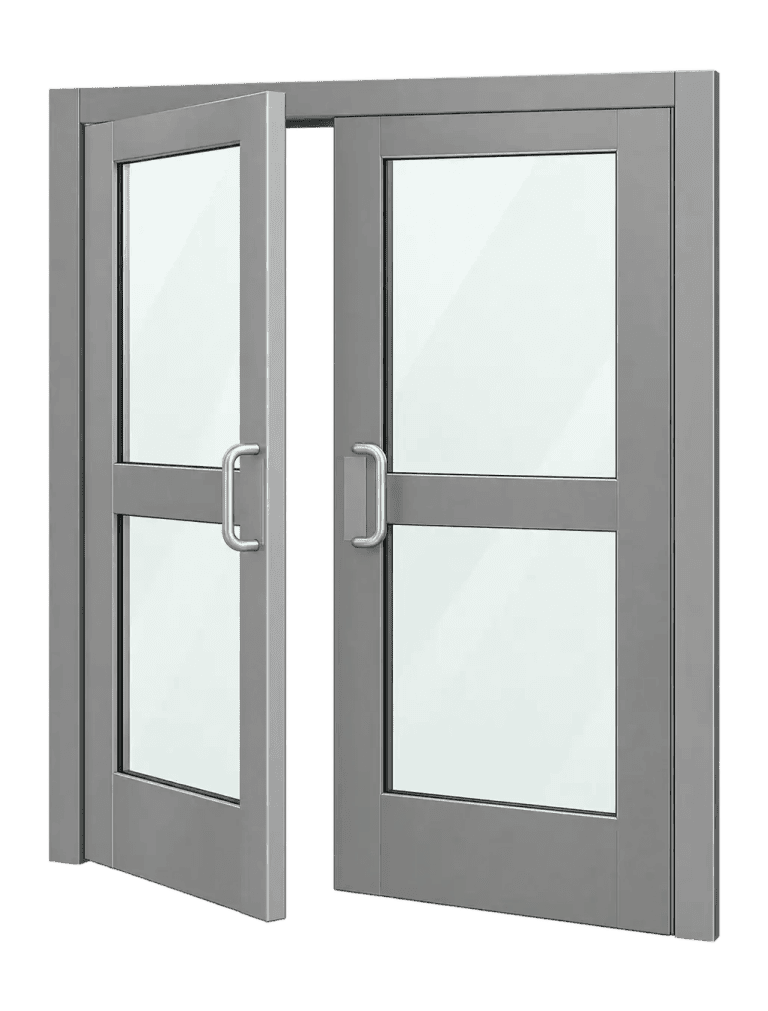
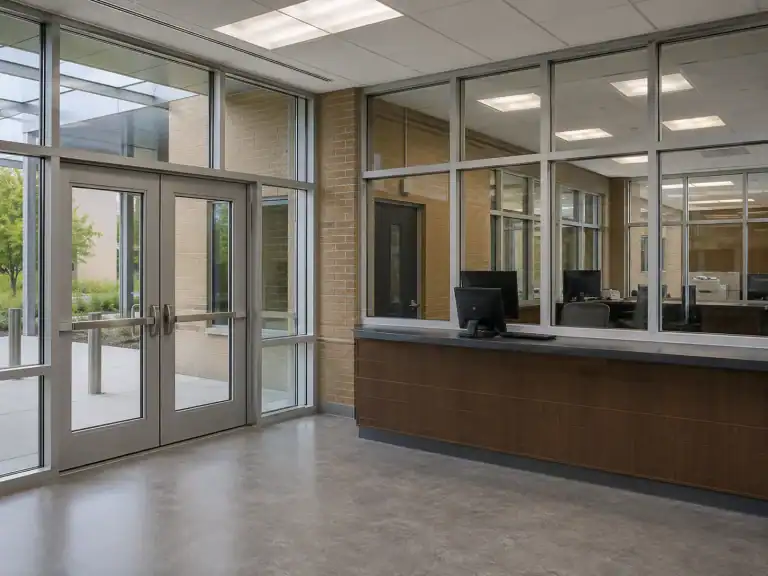
The aluminum door line offers clean, modern profiles suited to contemporary commercial storefronts, lobbies, and institutional entrances. Hollow metal options are available for applications where durability and a more traditional commercial aesthetic are the priority. All configurations are available in standard size (3' × 7') or custom dimensions to fit non-standard openings — which matters more than people expect, since older buildings rarely have perfectly standard rough openings.
The aesthetics are not a compromise you have to make. You can have a door that performs to UL 752 Level 3 or higher and still looks like it belongs in the building.
Common Questions About Bullet Resistant Doors — Answered Plainly
A few questions come up consistently when buyers are working through this decision, and they deserve straight answers.
The first one: are bullet resistant doors actually bulletproof? No. The term "bulletproof" is technically inaccurate, and any manufacturer using it liberally is being imprecise at best. No architectural product can guarantee absolute protection against every possible ballistic threat. What a certified bullet resistant door can do is stop specific projectiles at specific velocities, as defined by the UL 752 level it's been tested and listed to. That's meaningful, real protection — but it has defined parameters, and understanding those parameters is part of making a good purchasing decision.
The second: does a bullet resistant door also protect against forced entry? Not necessarily. Ballistic resistance and forced-entry resistance are separate engineering challenges tested to completely different standards. A door that stops a .44 Magnum round may or may not resist a sustained pry attack. If you need both capabilities, you need to specify both — and verify that the product you're buying has been independently tested for each.
The third: how do you know a rating is real and not just a marketing claim? Look for an independent UL 752 listing, not just language like "tested to UL 752 standards." A listing means the product was submitted to Underwriters Laboratories, tested under their protocols, and documented in their records. A claim that a product was "tested to" a standard without a formal listing is not the same thing. When in doubt, ask for the UL file number and verify it directly.
We've been manufacturing UL 752-listed ballistic security systems for more than 45 years. Our products are independently certified — not self-certified — and our engineering team includes a licensed Professional Engineer and LEED AP. That combination of long-term manufacturing experience and credentialed technical leadership matters when you're making a decision that affects the safety of the people in your building.
Choosing the Right Bullet Resistant Door for Your Facility
The difference between a standard security door and a bullet resistant door isn't a matter of degree — it's a matter of design, materials, testing, and certification. One was built to deter and delay. The other was built to stop a bullet. They are not interchangeable, and assuming otherwise leaves a gap in your building's protection that may not be visible until it's too late.
If you're evaluating your facility's entry points and want to understand what level of protection is actually appropriate for your situation, start with the right questions: What threats are you designing against? What standards apply to your facility type? Is the product you're considering certified as a complete system or just as individual components?
Action Bullet Resistant manufactures bullet resistant doors across the full UL 752 spectrum — Levels 1 through 10 — in wood veneer, aluminum, and hollow metal configurations, all engineered and built in the USA. If you're ready to talk through what your project actually needs, we're here for that conversation.