The short answer
Most buyers searching for bullet resistant glass cost run into the same wall: a confusing range of numbers with no real explanation behind them. This post breaks down what actually drives the price — material type, protection level, frame requirements, and project complexity — so you can walk into the quoting process with a clear head.
We've been engineering and manufacturing these systems for over 45 years, and we know the difference between a number that looks good on a webpage and one that reflects what a compliant, fully rated system actually costs. Read this before you request a single quote.
In this article
- What Does Bullet Resistant Glass Actually Cost?
- Why the Price Range for Bulletproof Glass Is So Wide
- The Frame Requirement Most Buyers Don't Know About
- What Drives Bullet Resistant Window Cost Beyond the Material
- How UL 752 Levels Affect Ballistic Glass Cost
- Is "Bulletproof Glass" Actually a Thing? What the Terminology Really Means
- Getting an Accurate Quote for a Bullet Resistant Glass System
If you've already spent time searching for bullet resistant glass pricing, you've probably noticed something frustrating: the numbers are all over the place. One source says $25 per square foot. Another says $500. Neither one explains why.
That gap isn't a pricing mystery — it's a knowledge gap. And it's the reason so many buyers end up either overpaying for the wrong product or under-specifying a system that won't hold up when it matters. This page is here to close that gap. We'll walk you through what actually drives the cost of a bullet resistant glass system, what questions to ask before you buy, and what separates a compliant installation from one that just looks the part.
What Does Bullet Resistant Glass Actually Cost?
The honest answer is that bullet resistant glass cost depends on a handful of variables that most pricing guides gloss over. At the lower end of the protection spectrum — think UL 752 Levels 1 through 3, which cover common handgun threats — glazing materials typically run $25 to $100 per square foot. Move into higher rifle-rated levels (Levels 4 through 8 and beyond), and that range climbs to $100 to $300 or more per square foot, with some specialty configurations reaching significantly higher.
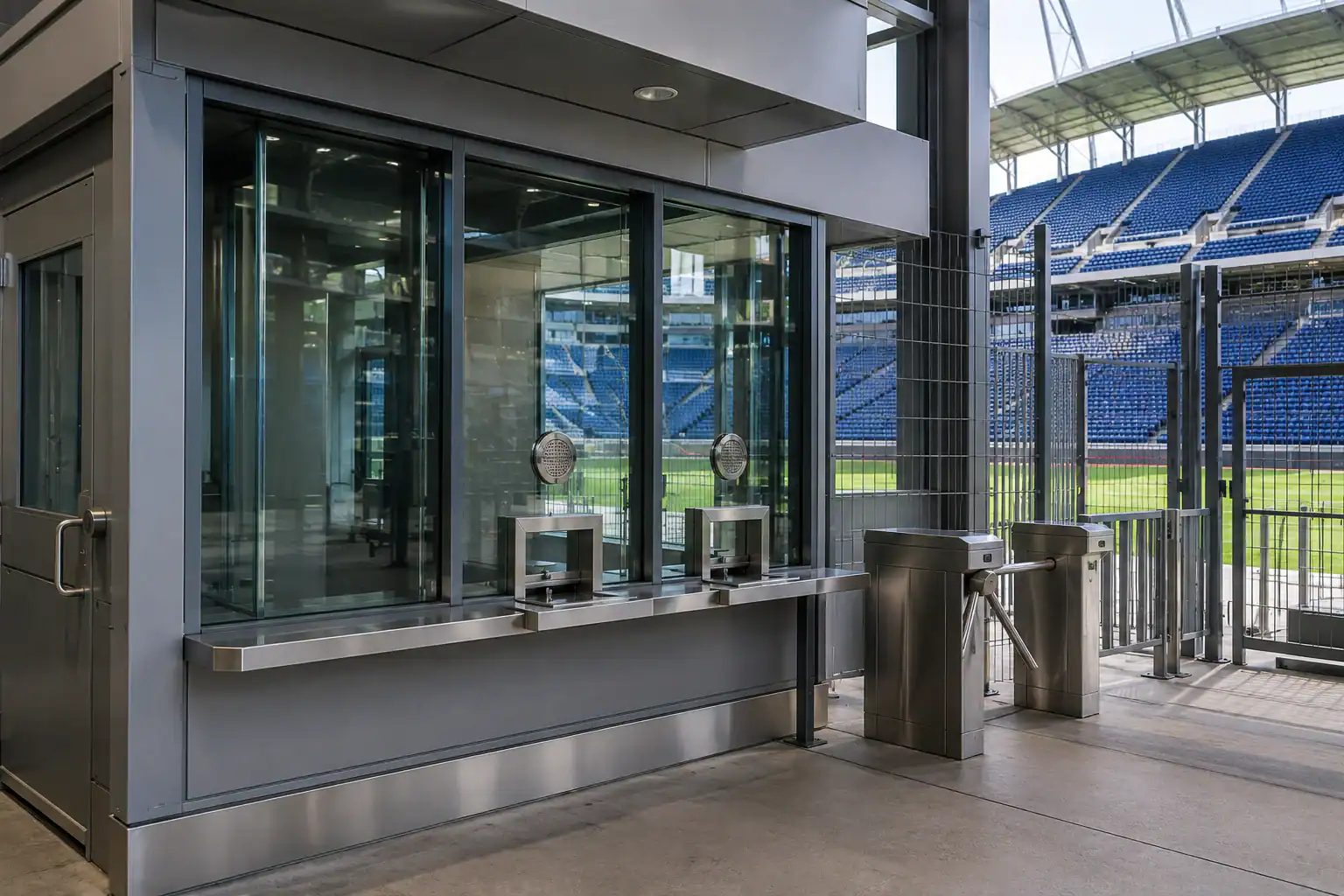
But here's what those per-square-foot figures don't tell you: the glass is only part of the cost. A complete bullet resistant system — including the rated frame, hardware, engineering, fabrication, and delivery — is what you're actually buying. Small transaction windows and cashier barriers typically start around $7,000 to $10,000 for a complete system. Mid-size storefront setups generally run $15,000 to $25,000 or more. The glazing alone is never the full picture.

Why the Price Range for Bulletproof Glass Is So Wide
The reason you see such a dramatic spread in bulletproof glass cost — from $25 a square foot to several hundred — comes down to a few specific factors that compound on each other. Understanding them is the fastest way to get a realistic number for your project.
Protection level is the biggest driver. UL 752, the primary U.S. standard for bullet-resistant building components, rates systems from Level 1 through Level 10. Level 1 is designed to stop 9mm handgun rounds. Level 8 handles 7.62mm rifle fire. The higher the level, the thicker, heavier, and more complex the glazing — and the more expensive the system. Most commercial applications — pharmacies, banks, retail storefronts, school security vestibules — fall somewhere between Levels 1 and 3. Government facilities and high-risk environments often require Levels 4 through 8 or even blast-rated systems built to UFC, ISC, and GSA criteria.
Material type matters just as much. The three most common options are acrylic, polycarbonate, and glass-clad polycarbonate. Acrylic is the most affordable and performs well at lower protection levels, but it can scratch and isn't suited for exterior applications without additional treatment. Polycarbonate is lighter and more impact-resistant but can yellow over time without UV protection. Glass-clad polycarbonate — layers of glass bonded with polycarbonate interlayers — offers the best combination of optical clarity, durability, and ballistic performance, and it's what most institutional and government projects specify. It's also the most expensive of the three.
Custom sizing adds cost, too. Real-world openings are almost never standard dimensions. Circular, oval, or otherwise non-rectangular openings require more complex fabrication than a straight rectangular frame. Add-ons like heat and sun protection coatings can increase base glazing costs by 10 to 30 percent. And if your project requires integrated communication — voice transmission systems or electronic intercoms built into the barrier — that adds to the total as well.
None of this is meant to make the process feel overwhelming. It's meant to explain why two projects that look similar on the surface can produce very different quotes. The variables are real, and they're worth understanding before you pick up the phone.
The Frame Requirement Most Buyers Don't Know About
This is the part that catches a lot of buyers off guard, and it's worth spending a moment on because it has real cost and safety implications. Bullet resistant glazing installed in a standard, unrated frame is not a compliant ballistic system. Full stop.
UL 752 applies to the complete assembly — the glass, the frame, and the hardware — not just the glazing pane on its own. If the frame isn't rated to the same level as the glass, the system has a structural weak point that a determined threat can exploit. The glazing may hold, but the frame can fail, and the result is the same. For any project where compliance matters — government buildings, federally regulated facilities, schools, financial institutions — this isn't a technicality. It's a requirement.
This is one of the most significant differences between buying from a manufacturer who builds complete rated systems and sourcing glazing from a general supplier. When we fabricate a bullet resistant window, door, storefront, or curtain wall, the entire assembly is engineered together — glazing, frame, hardware — to meet the specified UL 752 level. The system ships as a ready-to-assemble unit, and the certification covers the whole thing, not just the glass.
It's also worth noting what "UL Listed" actually means versus what it doesn't. Some products are self-certified by the manufacturer. A genuinely UL Listed product has been tested by Underwriters Laboratories against the specific threat criteria for its rated level, and that certification is verifiable. When you're evaluating quotes, asking for the UL test documentation — not just a claim — is a reasonable and important step. For federal projects, GSA and U.S. Marshal Service approval requirements add another layer of documentation that needs to be confirmed upfront.
The frame requirement isn't a cost add-on to resent. It's the reason a properly engineered system actually works.
What Drives Bullet Resistant Window Cost Beyond the Material
Once you understand that you're buying a system rather than a product, the cost conversation gets a lot clearer. The variables that drive total project cost aren't arbitrary — they reflect real engineering decisions that determine whether a system performs as specified.
Project complexity, opening dimensions, protection level, material selection, communication integration, and finish requirements all feed into the final number. So does the manufacturer's capability. A company that designs, engineers, and fabricates in-house can control quality and lead time in ways that a distributor assembling components from multiple vendors simply cannot.

How UL 752 Levels Affect Ballistic Glass Cost
UL 752 is the standard most U.S. buyers will encounter, and understanding how its levels map to real-world threats makes the pricing logic much easier to follow. The standard runs from Level 1 through Level 10, with each level defining a specific firearm and ammunition type that the rated assembly must withstand during testing.
Level 1 covers 9mm handgun rounds — the most common threat profile for retail, pharmacy, and cashier counter applications. Levels 2 and 3 add .357 Magnum and .44 Magnum threats respectively. These three levels cover the vast majority of commercial applications where the primary concern is robbery or targeted violence with a common handgun. Glazing and system costs at these levels are the most accessible, which is why most standard transaction windows and teller barriers fall in the $7,000 to $15,000 range for a complete installation.
Levels 4 through 8 move into shotgun and rifle territory, with Level 8 addressing 7.62mm rifle fire — the kind of threat profile relevant for government buildings, courthouses, military facilities, and high-value infrastructure. Systems at these levels are substantially heavier, thicker, and more expensive to fabricate. The glazing alone at Level 8 is a fundamentally different product than Level 1 glass, and the frame engineering requirements reflect that.
Levels 9 and 10 cover armor-piercing and specialty rounds. These are niche applications — typically government or defense — and pricing at these levels is project-specific by definition.
The 12th Edition of UL 752, published in October 2023, refined the testing protocols and introduced a designation system that categorizes threats by firearm type rather than numeric level alone. For buyers, the practical takeaway is that the standard is becoming more precise, not less — which is a good thing for anyone who needs to verify that a system actually does what it says it does.
Is "Bulletproof Glass" Actually a Thing? What the Terminology Really Means
The term "bulletproof glass" is everywhere — in news coverage, in product listings, in everyday conversation. It's also technically inaccurate, and understanding why matters more than it might seem.
There is no such thing as bulletproof glass. There is bullet resistant glass. The distinction isn't semantic hair-splitting — it reflects a real engineering reality. Any glazing system can be defeated by a projectile with sufficient energy, mass, or velocity. What UL 752 testing establishes is that a rated system will resist specific, defined threats under controlled conditions. That's a meaningful and valuable guarantee. It's just not the same as "immune to all bullets."
The three variables that determine whether a projectile defeats a glazing system are the weight of the bullet, its caliber, and its velocity. Heavier bullets carry more kinetic energy. Larger calibers create more surface area of impact. Higher velocity increases penetration force. A Level 3 system is engineered to slow and stop the specific combinations of those variables that UL 752 defines for that level. It won't stop a round it wasn't designed to stop.
This matters for buyers because it shapes how you should think about level selection. The goal isn't to buy the highest level available — it's to accurately assess the realistic threat profile for your facility and specify a system that addresses it. A pharmacy in a high-risk area may genuinely need Level 3. A government courthouse entrance may require Level 8 and blast resistance on top of that. Matching the specification to the actual threat is both a safety decision and a cost management decision.
We've been making this point for a long time, and it's one of the reasons we talk about bullet resistant systems the way we do — honestly, with the engineering context that helps buyers make informed decisions rather than fear-driven ones.
Getting an Accurate Quote for a Bullet Resistant Glass System
The most important thing to take away from this page is that bullet resistant glass cost isn't a single number — it's the output of a set of engineering decisions specific to your project. Protection level, material type, opening dimensions, frame requirements, finish specifications, and communication integration all feed into the final figure. A quote that doesn't account for all of those variables isn't a complete quote.
What you want from a manufacturer is transparency about what's driving the number — and the capability to engineer the entire system, not just supply the glass. That's the difference between a compliant, tested installation and one that looks right on paper but has gaps where it counts.
If you're in the early stages of scoping a project or trying to build a realistic budget, Action Bullet Resistant is a straightforward place to start. Over 45 years of manufacturing experience, USA fabrication, and full UL 752 coverage from Level 1 through Level 10 means we can give you an honest assessment of what your project actually requires — and what it will cost.


