
The short answer
Most people searching for "bulletproof glass" don't realize the term itself is a marketing myth. The glass industry - and the standard that governs it - uses "bullet resistant" for a reason: no glazing material is completely impenetrable under all conditions. Understanding that distinction isn't just semantics. It's the difference between specifying the right protection level for your facility and assuming you're covered when you're not. This post breaks down what bullet resistant glass actually is, how UL 752 ratings work, what materials are used, and what questions you should be asking before you buy.
In this article
- Why "Bulletproof Glass" Doesn't Exist - and What "Bullet Resistant" Actually Means
- How UL 752 Ratings Define What Bullet Resistant Glass Can Actually Stop
- What Happens to Bullet Resistant Glass After Impact
- What Is Bullet Resistant Glass Actually Made Of?
- Acrylic, Polycarbonate, and Glass-Clad Polycarbonate: Which Material Is Right for Your Application?
- Why the Frame and Installation Matter as Much as the Glass Itself
- Choosing the Right Bullet Resistant Glass Starts With Asking the Right Questions
If you've been searching for "bulletproof glass," you're not alone - and you're not wrong for using that phrase. It's the term most people reach for first. But here's something the industry doesn't always say clearly upfront: bulletproof glass doesn't exist. Not as a certified product. Not as a tested standard. The correct term is bullet resistant glass, and the difference isn't just vocabulary. It shapes everything from how products are rated and tested to what level of protection you actually need. By the end of this page, you'll have a clear picture of what bullet resistant glass is, how it's rated, and what to look for when you're making a real purchasing decision.
Why "Bulletproof Glass" Doesn't Exist - and What "Bullet Resistant" Actually Means
The phrase "bulletproof" implies something absolute - that no bullet, under any circumstances, can get through. That's not how glazing materials work. Every bullet resistant product on the market is engineered to resist specific threats at specific velocities, for a specific number of shots. Push beyond those parameters, and even the highest-rated glass can be defeated.
This isn't a technicality. It's the foundation of how the entire industry operates. The standard that governs architectural ballistic glazing in the United States - UL 752 - uses the term "bullet resistant" deliberately. Not bulletproof. Resistant. That word carries real meaning: protection up to a defined threat level, not protection against everything.
We say this not to be discouraging, but because honest communication matters when lives are on the line. The key word is "resistant" - and understanding that is the first step toward choosing the right product for your facility.
How UL 752 Ratings Define What Bullet Resistant Glass Can Actually Stop
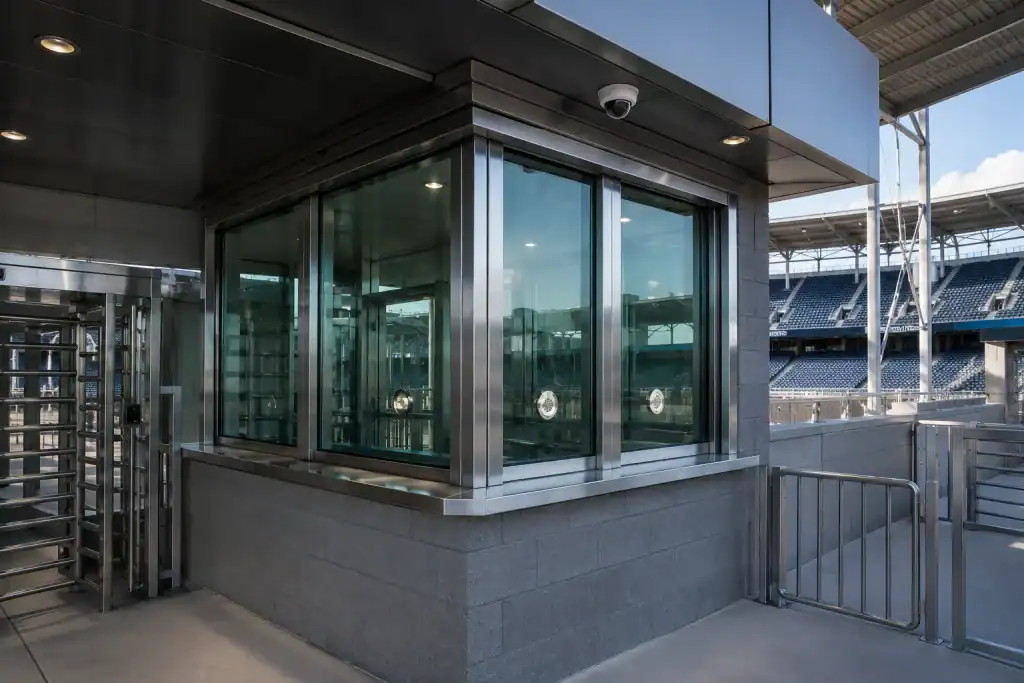
UL 752 is the standard that matters for architectural ballistic glazing - windows, doors, transaction windows, wall panels, and storefronts. Published by Underwriters Laboratories, it defines ten protection levels, each tied to a specific weapon type, ammunition, velocity, and number of shots the glazing must withstand without allowing penetration to the safe side.
Level 1, for example, requires the glazing to stop three shots from a 9mm handgun traveling at a minimum of 1,175 feet per second. That's the baseline - appropriate for retail storefronts, school entry vestibules, and reception windows in lower-risk environments. Level 3 steps up to a .44 Magnum. Level 5 handles 7.62mm rifle rounds. By the time you reach Level 8, you're looking at five shots from a 7.62mm tactical rifle - the kind of round associated with AK-47-class weapons. Levels 9 and 10 address specialized and armor-piercing threats.
Each level is tested independently. A product that passes Level 3 testing has been verified to stop .44 Magnum rounds - but it has not been tested against the threats defined at Level 5. This is why matching the protection level to the actual threat environment at your facility is so important. Over-specifying costs money and adds unnecessary weight and thickness to your installation. Under-specifying leaves a gap in protection that may not be visible until it's too late.
One more thing worth knowing: UL 752 is not the same as NIJ 0108.01. The NIJ standard applies to personal body armor - vests, helmets, personal protective equipment. It does not apply to architectural glazing. If someone quotes NIJ ratings for a window or door system, that's a red flag worth asking about.
The 12th Edition of UL 752 introduced updated designations, and both the 11th and 12th editions remain valid during the current industry transition. When reviewing product specs, it's worth confirming which edition the testing was conducted under.
What Happens to Bullet Resistant Glass After Impact
This is one of the most important questions buyers ask - and one of the least-discussed topics in product marketing. The short answer: bullet resistant glass is not permanently protective after impact. A glazing assembly that successfully stops a round has done its job in that moment, but the structural integrity of the material is compromised at the point of impact.
Each subsequent shot in that area encounters a weakened surface, and the cumulative effect of multiple strikes reduces the protection the system can offer. This is not a flaw in the product - it's physics. The energy absorption that makes bullet resistant glass work also means that energy has to go somewhere. It disperses through the layers of the glazing assembly, creating stress fractures, delamination, and micro-damage that isn't always visible to the naked eye.
A panel that looks intact after a strike may no longer meet its rated protection level. Any glazing assembly that has been struck by a projectile should be inspected and evaluated for replacement before it's relied upon again. Post-incident replacement protocols are a real part of responsible ballistic security planning, and they're something worth discussing with your manufacturer before installation - not after an event.
There's also the question of spalling. In some glazing configurations, the impact of a bullet can cause fragments of material to separate from the interior surface - the side facing the people you're trying to protect. Quality ballistic glazing systems are designed to minimize or eliminate spalling, typically through the use of polycarbonate backing layers or safety films that hold fragmented material in place. When evaluating products, it's worth asking specifically how the assembly handles spalling, not just whether it stops the initial round.
What Is Bullet Resistant Glass Actually Made Of?
Most people picture thick, slightly yellow-tinted plastic when they think of ballistic glass. That image is outdated. Modern bullet resistant glazing comes in several material configurations, each with different performance characteristics, weight profiles, optical clarity levels, and ideal applications.
The four primary types you'll encounter are monolithic acrylic, laminated polycarbonate, glass-clad polycarbonate, and laminated glass. Understanding the differences helps you ask better questions when specifying a system - and helps you recognize when a product recommendation actually fits your situation.
Acrylic, Polycarbonate, and Glass-Clad Polycarbonate: Which Material Is Right for Your Application?
Monolithic acrylic is the most basic form of bullet resistant glazing. It's a single solid sheet of acrylic material, typically used at lower protection levels - UL 752 Level 1 through Level 3. It offers good optical clarity and is relatively lightweight, but it scratches more easily than other options and is limited in the threat levels it can address. Thickness at Level 1 typically runs between 1¼ and 1⅜ inches.
Laminated polycarbonate takes a different approach. Rather than a single solid sheet, it's built from multiple layers of polycarbonate bonded together with interlayer materials. The layering is what gives it its ballistic performance - the outer layers absorb and distribute the energy of impact, while the inner layers prevent penetration. Polycarbonate is significantly lighter than glass at equivalent protection levels, which matters for large installations where frame load capacity and installation complexity are real considerations. It can be tuned by adjusting the number and thickness of layers, which makes it versatile across a wide range of UL 752 levels.
Glass-clad polycarbonate is the configuration most commonly specified for mid-to-high protection levels. It combines the hardness and scratch resistance of glass on the exterior surface with the energy-absorbing flexibility of polycarbonate on the interior. The glass outer layer is harder and more resistant to environmental wear; the polycarbonate inner layer handles the ballistic load. At Level 8, glass-clad polycarbonate can stop five shots from a 7.62mm tactical rifle - that's a meaningful capability for government buildings, financial institutions, and other high-risk environments.
Laminated glass - similar in construction to automotive safety glass - uses a polyvinyl butyral (PVB) interlayer bonded between glass lites. It's heavier than polycarbonate-based options but offers excellent optical clarity and is well-suited to applications where aesthetics and architectural integration are priorities. It also handles spalling well, since the PVB interlayer holds fragmented glass in place on impact.
Why the Frame and Installation Matter as Much as the Glass Itself
Here's something most buyers don't know to ask about: the glazing panel is only part of a ballistic system. The frame that holds it - and the way the system is installed - matters just as much as the glass itself.
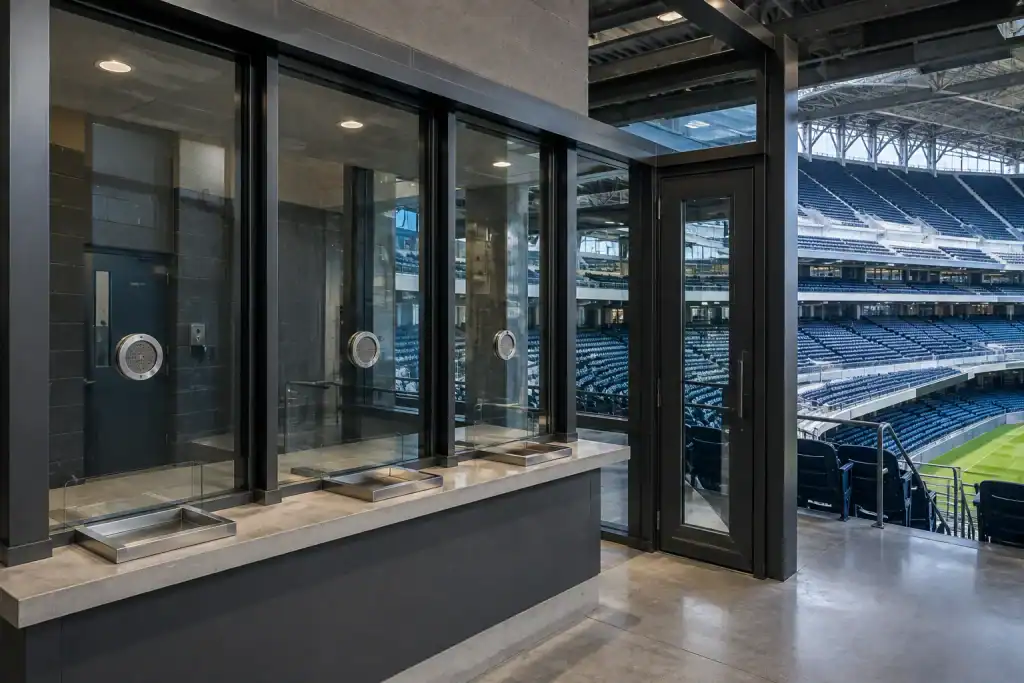
A bullet resistant glazing panel installed in a standard, non-rated aluminum storefront frame is not a bullet resistant system. The frame has to be engineered to capture and retain projectiles, to transfer the load of an impact without failing, and to maintain the integrity of the assembly after a strike. If the frame fails, the glazing panel - however well-rated - can be displaced, and the barrier is compromised.
This is why quality ballistic systems are tested and rated as complete assemblies, not as individual components. The glass, the frame, the hardware, and the installation method all contribute to the rated performance. When you're evaluating a product or reviewing a specification, the question isn't just "what is the UL 752 rating of the glass?" - it's "what is the UL 752 rating of the complete installed system?"
We engineer the full assembly - glazing, frame, and hardware - to perform as a certified unit. Our frames are available in durable aluminum, cold-rolled steel, and stainless steel, and each is engineered specifically to work with the glazing configuration it supports. We also design our systems to integrate architecturally - meaning the finished installation doesn't have to look like a security barrier to function as one.
It's also worth understanding that bullet resistant and blast resistant are not the same thing. Blast resistance addresses the pressure wave and structural load from an explosion, which is a fundamentally different threat profile than a ballistic impact. Some facilities - government buildings, embassies, high-risk commercial environments - need both. We manufacture blast resistant windows and doors alongside our ballistic product line, which means we can address compound threat environments without requiring multiple vendors or mismatched systems.
The bottom line is this: when you're specifying ballistic protection, you're specifying a system. Any manufacturer or vendor who talks only about the glass and not the frame, the hardware, and the installation is leaving part of the story out.
Choosing the Right Bullet Resistant Glass Starts With Asking the Right Questions
The difference between "bulletproof glass" and bullet resistant glass isn't just terminology - it's the difference between a marketing phrase and a tested, certified standard. Knowing that distinction, understanding UL 752 protection levels, and recognizing that a complete ballistic system includes the frame and not just the glazing panel puts you in a much stronger position to make the right call for your facility.
No product stops every threat. The right product stops the threats your environment actually faces - and it does so as a verified, independently tested system, not a self-certified claim.
If you're in the early stages of evaluating ballistic glazing for a new construction project, a renovation, or a post-incident upgrade, Action Bullet Resistant is a good place to start the conversation. We've been building custom-engineered, UL 752-rated systems for banks, schools, government facilities, and high-risk commercial environments for over 45 years - and we're happy to help you figure out what level of protection your situation actually calls for.


